How and Why to Skim Soups and Stocks for a Clear Broth
Skimming soups and stocks is a simple technique that yields a cleaner, clearer finished liquid. As you simmer bones, meat, or legumes, proteins and tiny particles coagulate and rise to the surface, forming a grayish or cloudy foam often called scum. If left in the pot, this material can make the broth look dull and slightly bitter in taste. Removing it improves both the appearance and the flavor of your stock or soup.
The process is straightforward and requires minimal equipment: a spoon, a fine-mesh skimmer, or a ladle will do. The key is to watch the pot during the first phase of the simmer. As the heat extracts proteins and impurities, they will gather on the surface. Gently skim them away and discard. Repeat this every few minutes until little or no foam appears. This usually takes 20–30 minutes, depending on the size of the pot and the ingredients.
Technique tips:
- Start with cold water when making stock. Gradually heating ingredients helps more impurities rise to the surface where you can remove them.
- Keep the liquid at a gentle simmer rather than a rolling boil. A vigorous boil breaks up the particles and emulsifies them into the broth, producing lasting cloudiness. A low, steady simmer encourages scum to gather and makes it easier to lift away.
- Use a slotted spoon or a flat skimmer to collect the foam. For larger batches, use a fine-mesh skimmer to speed the process. Dip the skimmer close to the surface and drag the foam toward the rim to lift it out.
- Wait to add delicate vegetables or herbs until after you’ve finished skimming. Vegetables can release their own particles or break up in the liquid, increasing the load of material rising to the top and making skimming more tedious.
- Have a small bowl or container nearby to discard the skimmed material. This keeps your workspace tidy and prevents reintroducing impurities into the pot.
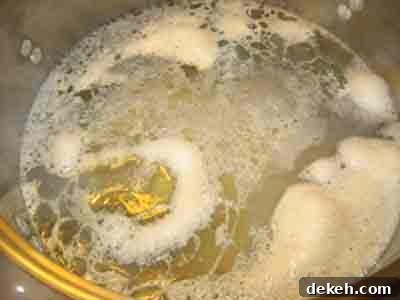
Here’s what the scum typically looks like while simmering:
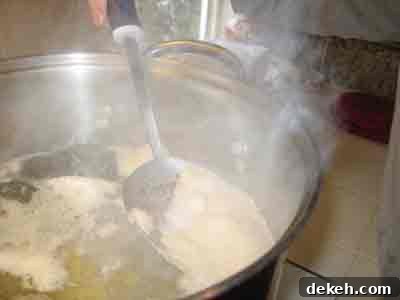
Using the right tool makes the job quick and effective. A dedicated skimmer has a broad, shallow surface that collects foam without removing much liquid; a spoon works fine for smaller pots. Move slowly and focus on the surface layer where the foam accumulates, rather than stirring the pot.
Use a skimmer or a spoon to scoop it out:
After you’ve skimmed most of the foam, you’ll notice the surface becomes clearer and the broth looks brighter. If you still see small particles, continue occasional skimming until very little forms. Once the initial phase is complete, you can lower the heat further and add any vegetables or aromatics needed to finish the recipe without clouding the stock.
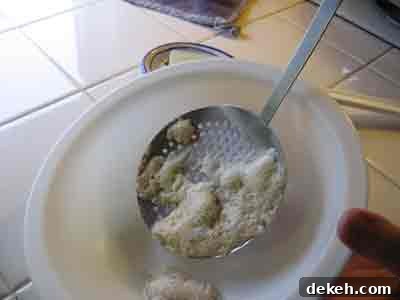
Dump it into a bowl to be thrown away.
Final notes on clarity and flavor:
- Clarifying for presentation: For consommés or very clear broths, skim thoroughly and consider additional clarifying techniques if needed, such as using egg whites to bind and remove finer particles.
- Don’t over-skim: Removing the surface foam is about improving clarity and taste; you don’t need to strip the pot of all flavor components. The goal is to remove the undesirable solids, not the dissolved flavor compounds that make a good stock.
- Strain when done: After simmering and skimming, strain the stock through a fine sieve or cheesecloth to catch any remaining solids for an even clearer result.
Skimming is a small step that makes a noticeable difference. With a little attention during the first half hour of simmering, you’ll end up with a clear, clean, and flavorful broth that improves any soup, sauce, or recipe that calls for stock.